What is health data privacy? Your rights, explained
What is health data privacy? Learn your rights and how to protect your sensitive health information from misuse and threats. Discover now!

What is health data privacy? Your rights, explained
Your health records contain some of the most sensitive details about your life. Yet over 1.5 million people had their protected health information exposed in March 2026 alone. Understanding what is health data privacy is not just an abstract legal concept. It is your first line of defense against identity theft, discrimination, and the loss of control over deeply personal information. This guide explains exactly what health data privacy means, what laws protect you, and what you can do right now to stay informed and in control.
Table of Contents
- What is health data privacy and why does it matter?
- Understanding protected health information (PHI) under HIPAA
- How HIPAA’s Security Rule protects your electronic health data
- When and how your health data can be shared legally
- Practical tips for patients, families, and caregivers managing health data privacy
- Why a patient-first approach to health data privacy matters more than strict barriers
- How MedFiles.ai helps protect your health data privacy
- Frequently asked questions
Key Takeaways
| Point | Details |
|---|---|
| Health data privacy | Protecting your personal health information prevents misuse while enabling quality healthcare. |
| HIPAA protections | The Privacy and Security Rules set standards for use, disclosure, and safeguarding of health data. |
| Patient rights | You have rights to access, amend, and restrict sharing of your protected health information. |
| Legal sharing limits | Health data may be shared legally without consent only when necessary for care, payment, or operations. |
| Practical management | Using secure digital tools and verifying vendor compliance helps families manage health data privacy effectively. |
What is health data privacy and why does it matter?
Health data privacy means protecting your personal health information from being accessed, used, or shared without your knowledge or permission. It covers everything from your diagnosis records and prescription history to billing data and genetic test results.
But privacy is not just about secrecy. It is about control. You share your health information with doctors because you need care. The question is who else gets to see it, and for what purpose.
A WHO 2025 review describes health data privacy as implementing measures that guarantee confidentiality (limiting access to authorized parties), integrity (preventing improper changes), and availability (ensuring your data is accessible when you need it). That three-part balance is at the heart of what healthcare data privacy is trying to achieve.
Why does this matter so practically? Because health data is uniquely valuable and uniquely risky. Stolen financial credentials can be canceled. A stolen health record cannot. It can be used to fraudulently bill insurers, obtain prescriptions, or deny you coverage.
Here is what health data privacy actually protects you from:
- Unauthorized disclosure: Your diagnosis shared with an employer without consent
- Data breaches: Hackers accessing hospital systems and selling records on the dark web
- Misuse by third parties: Health apps selling your data to advertisers
- Improper internal access: A staff member viewing your records out of curiosity
- Insurance or employment discrimination: Based on mental health history or genetic data
Understanding examples of healthcare data helps you recognize exactly what information is at stake in any privacy situation.
Understanding protected health information (PHI) under HIPAA
In the United States, the Health Insurance Portability and Accountability Act, known as HIPAA, is the primary law governing health data privacy. Its core concept is protected health information, or PHI.

According to CMS 2025 guidance, PHI includes any individually identifiable health information relating to a past, present, or future physical or mental health condition, the provision of healthcare, or payment for care. It applies to information transmitted or maintained in any format, including paper, electronic, and spoken communication.
PHI includes 18 categories of identifiers, such as:
- Name
- Address (including street, city, county, and zip code)
- Dates (birth date, admission date, discharge date)
- Phone and fax numbers
- Email addresses
- Social Security numbers
- Medical record numbers
- Health plan beneficiary numbers
- Account numbers
- Certificate and license numbers
- Vehicle identification numbers
- Device identifiers and serial numbers
- Web URLs
- IP addresses
- Biometric data (fingerprints, voice prints)
- Full-face photographs
- Any other unique identifying number or code
- Geographic data smaller than a state
Who must comply? HIPAA applies to covered entities (doctors, hospitals, health plans, and healthcare clearinghouses) and their business associates (vendors like billing companies, cloud storage providers, and IT contractors who handle PHI on their behalf).
As a patient, HIPAA gives you the right to access your records, request amendments if information is incorrect, and receive an account of who your data has been disclosed to. Providers must respond within 30 to 60 days.
Pro Tip: Always request a copy of your records after a major treatment or hospitalization. Errors in medical records are more common than most people realize, and catching them early can prevent billing disputes or incorrect future care decisions.
Good healthcare information management starts with knowing exactly what is in your file.
How HIPAA’s Security Rule protects your electronic health data
While the HIPAA Privacy Rule covers all PHI, the Security Rule focuses specifically on electronic PHI, called ePHI. It requires covered entities to put three categories of safeguards in place.
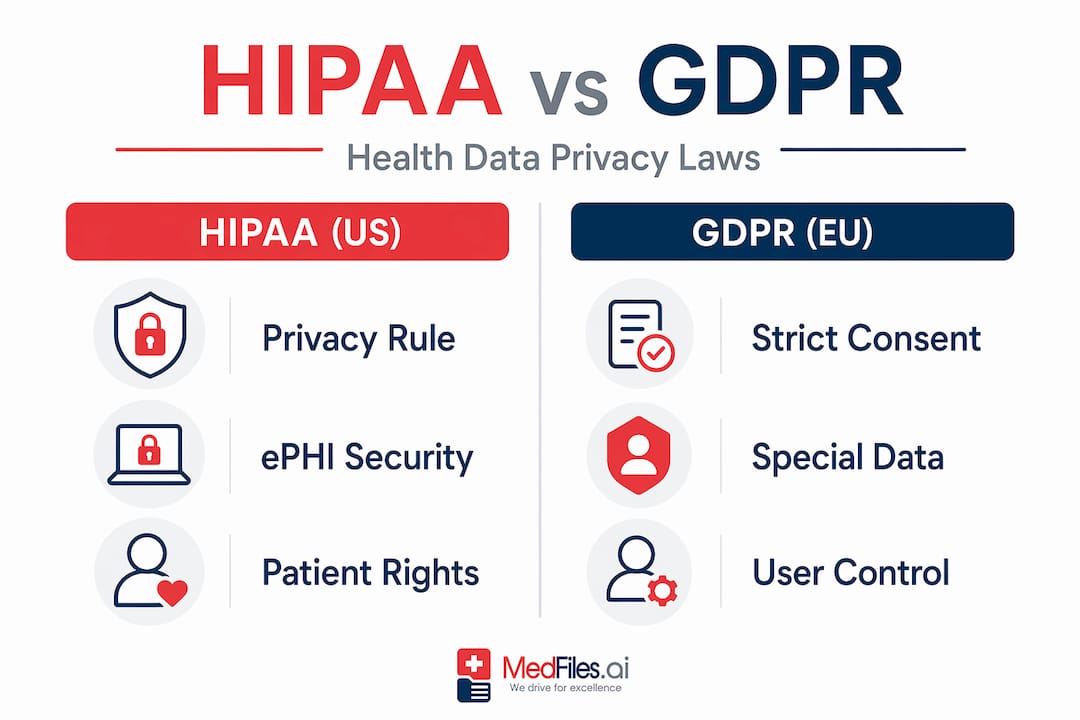
According to AMA 2026 guidance, covered entities must implement administrative, physical, and technical safeguards to ensure the confidentiality, integrity, and availability of all ePHI. A mandatory risk analysis must be conducted annually or after any major organizational change.
Here is what each safeguard category actually means in practice:
- Administrative safeguards: Written policies, staff training programs, designated privacy officers, and procedures for investigating security incidents
- Physical safeguards: Locked server rooms, workstation controls, device and media disposal procedures, and controlled facility access
- Technical safeguards: Access controls (unique user IDs and passwords), automatic logoff, audit controls tracking who accessed what data, and transmission security such as encryption
The annual risk analysis requirement is significant. It means health data security measures are not a one-time setup. Organizations must actively reassess threats, document vulnerabilities, and show evidence of ongoing corrective action.
One detail most patients do not know: workforce training is a specific compliance requirement, not optional. If a staff member accidentally emails your records to the wrong person, the organization can be held liable if they cannot show that proper training was in place.
Pro Tip: If you receive care from a new provider, ask directly how they store and protect your ePHI. A reputable provider will have clear answers. Vague or dismissive responses are a genuine red flag.
Protecting your own records long term requires the same rigor. Learning about long-term medical records safety gives you a practical framework to apply at home.
When and how your health data can be shared legally
This is where many patients feel the most confused. Can a hospital share your records without asking you? Yes, in certain cases. But the rules are specific.
Under the HIPAA Privacy Rule, covered entities can share PHI without your authorization for three core purposes: treatment, payment, and healthcare operations. The critical limit is the minimum necessary standard, meaning only the information genuinely needed for that purpose should be shared.
Permissible disclosures without authorization also include:
- Public health reporting (disease surveillance)
- Abuse or neglect reporting required by law
- Judicial and administrative proceedings
- Law enforcement under specific legal conditions
- Organ donation and transplant coordination
- National security and intelligence activities
Now compare that to how the European Union handles health data. Under GDPR Article 9, health data is classified as a special category requiring either explicit consent or one of ten defined exemptions before it can be processed. Patients in EU countries also have rights to erasure and rectification, with organizations required to respond within one month.
| Feature | HIPAA (U.S.) | GDPR (EU) |
|---|---|---|
| Default for treatment sharing | Permitted without consent | Requires consent or exemption |
| Minimum necessary standard | Required | Required (data minimization) |
| Patient right to access | Yes, within 30-60 days | Yes, within 1 month |
| Right to erasure | Limited | Broad (“right to be forgotten”) |
| Breach notification | Required if risk above low | Required within 72 hours |
| Penalties for violation | Up to $1.9M per violation type | Up to 4% of global annual revenue |
The practical takeaway: HIPAA gives you meaningful rights, but GDPR is structurally stricter. If you live in the U.S. and want GDPR-level control, you need to proactively exercise your HIPAA rights and choose providers and apps that go beyond the legal minimum.
Understanding secure medical records sharing helps you share only what is necessary, with only who needs it.
Practical tips for patients, families, and caregivers managing health data privacy
Knowing your rights is one thing. Using them is another. Here are concrete steps you can take right now.
Request and review your records regularly. Under HIPAA, you can ask providers for a full copy of your file. Review it for errors, outdated diagnoses, or information that should have been removed.
Ask about restrictions. Patients can request that providers limit how they share PHI, and providers accept these requests 20 to 30 percent of the time. This is especially useful if you want to keep a sensitive diagnosis away from certain family members or insurers.
Understand breach notification. Per CMS 2025 breach rules, providers only notify you if a risk assessment shows more than a low probability that your PHI was compromised. But all breaches must be documented internally. If you suspect your records were involved in an incident, ask for documentation.
Verify Business Associate Agreements. Any vendor or app handling your PHI must have a BAA in place with your provider. Ask your telehealth platform, health app, or digital records service directly whether a BAA exists.
Caregivers: get documentation first. HIPAA allows personal representatives (such as those holding power of attorney) to access a patient’s records, but verbal consent is not sufficient. Providers must verify legal documentation before granting access. Prepare this paperwork in advance to avoid delays in an emergency.
“Health data privacy is not just a legal obligation. It is the foundation of trust between patients and the healthcare system. Without it, people avoid seeking care for fear their information will be misused.”
Pro Tip: Use a dedicated digital health storage platform rather than generic cloud services like email or consumer file storage. Generic platforms are not built for PHI and often lack BAAs, which puts both you and your provider at legal risk.
Organizing everything in one place makes a real difference. See how to organize medical records securely for your whole family. The digital health management benefits for families managing multiple records are substantial.
Why a patient-first approach to health data privacy matters more than strict barriers
Here is something the standard legal guides do not say: HIPAA compliance is not the same as good privacy practice. Too often, organizations use HIPAA as a shield. They say no to data sharing requests, delay record access, and restrict information flow in ways that hurt patients, not protect them.
Healthcare legal departments frequently hinder innovation through overly cautious HIPAA interpretations. The call is for a shift to “yes, but with guardrails” rather than blanket refusals.
We agree with that framing. Privacy regulations should be guardrails, not walls.
Think about what happens when a caregiver cannot access a hospitalized parent’s records because of rigid compliance procedures. Or when a patient cannot share their records with a specialist because the systems do not talk to each other, and no one wants to take responsibility for the data transfer. These are privacy failures of a different kind. They are failures of access, not protection.
The best outcome for patients is a system where you control your own data. You decide who sees it. You share it when it benefits your care. You restrict it when it does not. That requires HIPAA as a floor, not a ceiling. It requires providers to invest in real interoperability and patient-facing tools, not just legal defensiveness.
The good news: digital medical history innovations are making patient-controlled health records genuinely achievable. You do not have to wait for the healthcare system to get it right. You can start managing your own records today.
How MedFiles.ai helps protect your health data privacy
You now understand what health data privacy means, what laws protect you, and what actions you can take. The next step is putting that knowledge into practice with tools built specifically for this purpose.
MedFiles.ai for patients is built on HIPAA-ready infrastructure with end-to-end encryption, so your records are stored and shared securely by design. You control exactly who can access your information, whether that is your doctor, a specialist, or a family caregiver. Every upload is automatically organized, and records are accessible instantly whether you are at home, traveling, or in an emergency room. For families managing multiple profiles, MedFiles.ai supports multi-profile management so caregivers can handle records for children, elderly parents, and even pets in one place. Explore plans for individuals and families and find the level of storage and sharing that fits your life.
Frequently asked questions
What types of health information are protected under health data privacy laws?
Health data privacy laws protect individually identifiable information related to your physical or mental health, healthcare services provided, and payment details, including identifiers like your name, birth date, and medical record number. Under HIPAA, 18 specific identifiers are covered when linked to health or payment information.
Can my health data be shared without my permission?
Yes. Under HIPAA, your health data can be shared without your authorization for treatment, payment, and healthcare operations. However, only the minimum necessary information may be disclosed, which limits how broadly it can be shared even in permissible situations.
What should I do if I suspect a health data breach involving my records?
Ask your provider directly for details about the incident and whether a formal breach notification was issued. Monitor your insurance statements and financial accounts for unusual activity, and file a complaint with the HHS Office for Civil Rights if you believe your HIPAA breach notification rights were not honored.
How can families or caregivers access and manage a patient’s health data securely?
Caregivers with legal authority, such as a power of attorney, can access a patient’s records after providers verify the documentation. Per HIPAA personal representative rules, verbal consent is not enough, so prepare legal paperwork in advance and consider using a secure digital platform to manage shared family records.
Are all health apps required to follow HIPAA privacy rules?
No. Only apps that work directly with HIPAA-covered entities are required to follow HIPAA. Others fall under state privacy laws, which vary widely. Always check whether an app has a Business Associate Agreement in place and whether it offers opt-in controls before sharing your health data with it.