Is Texting HIPAA Compliant? A Provider's Guide
Discover how texting patient information can meet HIPAA compliance requirements, ensuring secure communication in healthcare.

Is Texting HIPAA Compliant? A Provider’s Guide
Texting patient information can be HIPAA compliant, but only under specific conditions. The decisive factor is not whether you use a phone — it’s whether PHI travels through a platform that meets the HIPAA Security Rule’s technical safeguards and is covered by a signed Business Associate Agreement (BAA). Standard SMS and MMS fail that test automatically. HHS confirms that messages without PHI are permissible, but transmitting PHI over plain SMS is a potential breach because it lacks encryption, access controls, and audit trails.
Before you text any patient information, check three things:
- Secure platform: You are using a Secure Texting Platform (STP) configured with encryption in transit and at rest, access controls, and audit logging — not a consumer messaging app.
- Signed BAA: Your vendor has executed a Business Associate Agreement with your organization. A vendor’s marketing claim of “HIPAA compliance” is not a substitute.
- Policies, training, and minimum necessary: Your organization has documented policies, trained staff, and applied the minimum necessary standard to every message’s content.
Pro Tip: For urgent, brief communications (a critical lab flag, a care-team handoff), a properly configured STP is acceptable. For anything requiring detailed PHI — full medication lists, diagnostic reports, imaging — route through your EHR’s secure messaging or a secure portal instead.
Key Takeaways
Texting PHI is HIPAA compliant only when a signed BAA, a properly configured STP, documented policies, and staff training are all in place simultaneously.
| Point | Details |
|---|---|
| Plain SMS is never compliant for PHI | Standard SMS lacks encryption, access controls, and audit trails — use a configured STP with a signed BAA. |
| Three requirements must coexist | A secure platform, a signed BAA, and documented policies with staff training are all required; any one alone is insufficient. |
| CMS and Joint Commission allow texting orders | Texting orders is permissible via an STP meeting Security Rule and CoP requirements, but CPOE remains preferred and EHR capture is required. |
| Penalties scale with willfulness | OCR investigations, civil monetary penalties, and corrective action plans are all possible outcomes of impermissible PHI disclosure by text. |
| Medfiles supports secure alternatives | When texting is not appropriate, Medfiles provides encrypted, auditable document sharing for patients and clinical review access for providers. |
Table of Contents
- When texting is a HIPAA violation: common mistakes to stop now
- What counts as PHI in a text message
- Who must follow HIPAA texting rules — and what a BAA actually requires
- Technical safeguards your texting platform must provide
- Administrative requirements: policies, training, and consent
- What CMS and the Joint Commission say about texting orders
- Penalties and breach-notification requirements
- Step-by-step checklist to implement HIPAA-compliant texting
- Safer alternatives to texting PHI — and when to use them
- The compliance mindset that actually protects your patients
- Secure record sharing that supports your compliance workflow
- Sources
When texting is a HIPAA violation: common mistakes to stop now
Most texting violations are not the result of bad intent. They happen because a workflow that feels fast and familiar turns out to be legally exposed. Here are the scenarios that generate the most risk.
- PHI over plain SMS: A provider texts a patient’s diagnosis, medication, or test result from a personal phone. Standard SMS has no encryption, no access control, and no audit trail.
- Personal devices without mobile device management (MDM): Staff use personal phones with no MDM policy in place. If the device is lost or stolen, there is no remote wipe capability and no way to confirm whether PHI was accessed.
- Vendor refuses to sign a BAA: A messaging app markets itself as “HIPAA-friendly” but declines to execute a BAA. Without that agreement, the provider bears full legal responsibility for any disclosure.
- Template creep: An appointment reminder starts as non-PHI (“Your appointment is Tuesday at 2 PM”) but a staff member adds the reason for the visit or a medication instruction, converting it into PHI mid-workflow.
- Texting PHI to a family member without authorization: A provider texts a patient’s diagnosis to a spouse via SMS without a signed authorization or a documented exception under the Privacy Rule.
The dual-risk problem: Improperly automated texting exposes you to two separate enforcement regimes. HIPAA governs PHI disclosure; the Telephone Consumer Protection Act (TCPA) governs consent for automated messages. A single unsolicited text with PHI can trigger both an HHS Office for Civil Rights (OCR) investigation and a TCPA claim. Document both HIPAA disclosure preferences and TCPA opt-in records at intake — they are separate legal requirements.
What counts as PHI in a text message
Protected Health Information (PHI) is any individually identifiable health information held or transmitted by a covered entity or its business associates. In a text, that means any combination of a health-related detail and an identifier that links it to a specific person.
| Text Content | PHI? | Notes |
|---|---|---|
| “Your appointment is Thursday at [time] at Main Street Clinic” | No | No health condition revealed |
| “Your appointment is Thursday — please bring your insulin” | Yes | Medication reveals condition |
| “Lab results are ready. Please call us.” | No | No result disclosed |
| “Your A1C test result is available. Dr. Chen wants to discuss.” | Yes | Diagnosis-linked result + provider name |
| “Reminder: follow up for your knee surgery on Friday” | Yes | Procedure linked to patient identity |
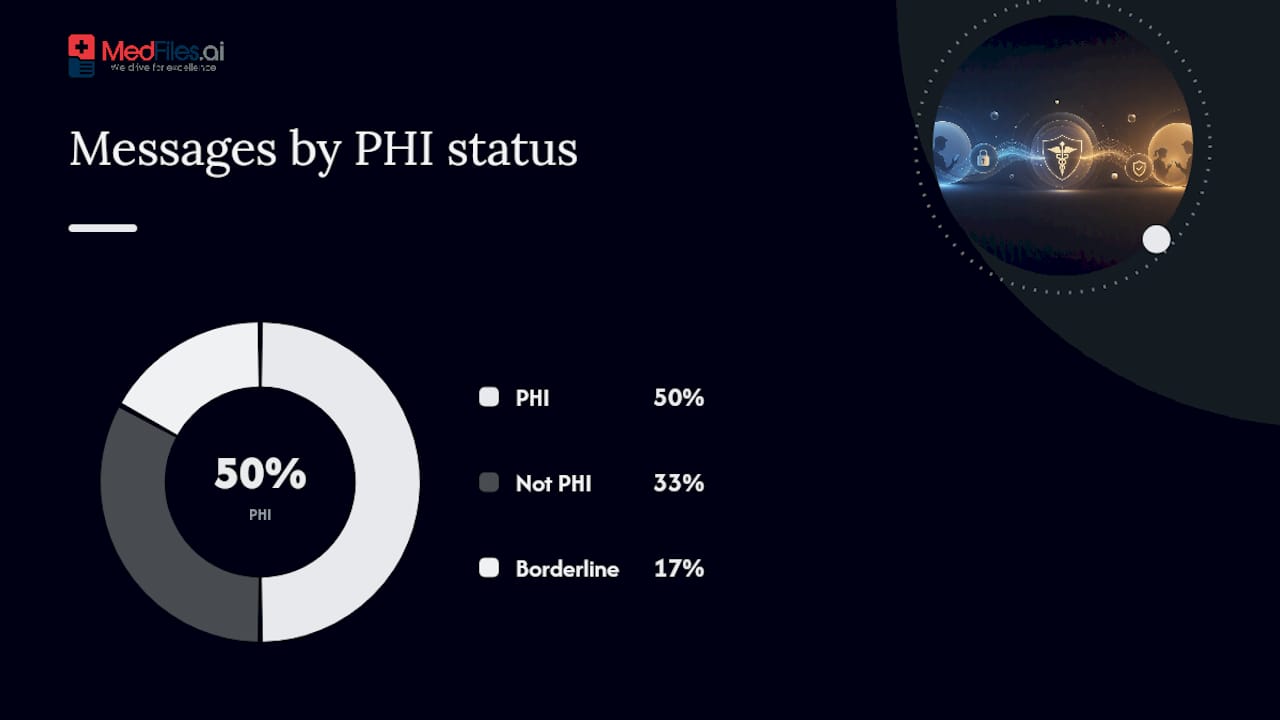
| “Hi John, your prescription is ready for pickup” | Borderline | Name + prescription = likely PHI |
Edge cases create the most exposure. A patient’s name alone is not PHI. A health condition alone is not PHI. Together, they are. Context matters: a text that seems generic in isolation can become PHI when combined with the recipient’s known identity, a prior message thread, or a visible subject line. Apply the minimum necessary standard — if a detail is not required to accomplish the communication’s purpose, leave it out.
- Appointment reminders with only name, time, and location are generally safe on standard SMS.
- Any message that reveals why a patient is being seen, what they are being treated for, or what their results show is PHI.
- Templated reminders can drift into PHI when staff customize them; audit templates regularly.
Who must follow HIPAA texting rules — and what a BAA actually requires
HIPAA applies to covered entities (hospitals, physician practices, health plans, healthcare clearinghouses) and their business associates (any vendor or contractor that creates, receives, maintains, or transmits PHI on their behalf). If your messaging vendor handles PHI, it is a business associate and a BAA is legally required before any PHI flows through its platform.
A BAA is not a checkbox. It must include:
- Permitted uses and disclosures: What the vendor may do with PHI.
- Safeguard obligations: The vendor’s commitment to implement appropriate protections.
- Breach reporting timelines: The vendor must notify you of a breach within a defined period (HHS sample provisions suggest prompt notification).
- Right-to-audit clause: Your organization’s right to verify the vendor’s compliance.
- Subcontractor flow-downs: The vendor must require the same protections from any subcontractor that touches PHI.
- Data return or destruction: What happens to PHI when the contract ends.
Pro Tip: Ask every prospective texting vendor for their BAA before you evaluate features. If they hesitate or offer a modified version that removes audit rights or breach-notification timelines, that is a red flag — not a negotiation.
The HHS Security Rule guidance is clear: compliance is the combination of policy, technology, and documentation. A vendor’s marketing claim of “HIPAA compliance” carries no legal weight without a signed BAA and documented safeguards on your side.
Technical safeguards your texting platform must provide
The HIPAA Security Rule, codified at 45 CFR 164.306, requires covered entities to implement reasonable and appropriate safeguards to protect the confidentiality, integrity, and availability of electronic PHI. For a texting platform, that translates into specific technical controls.
Required technical safeguards:
- Encryption in transit: Messages must be encrypted using TLS 1.2 or higher. Standard SMS travels unencrypted across carrier networks.
- Encryption at rest: Stored messages must be encrypted, commonly with AES-256.
- Unique user IDs and access controls: Each user must have a unique login. Shared accounts fail this requirement.
- Automatic logoff: Sessions must time out after a defined period of inactivity.
- Audit logs: The platform must log who sent what, to whom, and when — and those logs must be exportable and retained per your retention policy.
- Transmission security: End-to-end encryption (E2EE) is the strongest option; at minimum, server-side encryption with TLS is required.
- Remote wipe / MDM integration: If staff use mobile devices, the platform must support remote wipe in the event of loss or theft.
- No SMS fallback: The platform must not silently downgrade to plain SMS when a recipient’s device cannot receive the encrypted message.
Vendor verification checklist:
| Requirement | What to ask the vendor |
|---|---|
| BAA availability | “Will you sign our BAA before we go live?” |
| Encryption standards | “What encryption do you use in transit and at rest?” |
| Audit log retention | “How long are logs retained and can we export them?” |
| EHR integration | “Can messages be exported or auto-captured into our EHR?” |
| Disaster recovery | “What is your RTO/RPO and where is data backed up?” |
| Data deletion | “How is PHI deleted at contract termination?” |
| Subcontractor BAAs | “Do your subcontractors sign BAAs?” |
As Psychiatry, some vendors cite AES-256 and TLS in their marketing, but encryption alone does not equal compliance. Configuration, access controls, and administrative policies must accompany the technical layer.
Administrative requirements: policies, training, and consent
Technical controls protect the channel. Administrative safeguards protect the workflow. 45 CFR 164.308 requires documented administrative safeguards that apply directly to texting workflows.
Administrative safeguard checklist:
- Conduct and document a formal risk analysis that includes texting as a communication channel.
- Publish a written texting policy covering who may send PHI by text, on which platforms, and under what circumstances.
- Designate a Security Official responsible for overseeing the texting program.
- Deliver workforce training on the policy before go-live and annually thereafter; document completion.
- Establish a sanction policy for staff who violate the texting policy.
- Define retention rules for text messages containing PHI.
- Implement an identity verification step before texting PHI to a patient or care team member.
Consent: two separate requirements
| Requirement | Governing law | What to capture |
|---|---|---|
| HIPAA disclosure preference | HIPAA Privacy Rule | Patient’s preference for receiving health information by text; document in the medical record |
| TCPA opt-in | Telephone Consumer Protection Act | Express written consent for automated or marketing texts; separate from HIPAA consent |
These are not interchangeable. A patient who consents to HIPAA disclosures by text has not necessarily given TCPA consent for automated reminders. Capture both at intake and document both in the record.
Sample policy clause topics to include in your written texting policy:
- Approved platforms and prohibited platforms (by name)
- Permitted content categories and prohibited content categories
- Minimum necessary review before sending
- Verification of recipient identity before sending PHI
- Retention and deletion schedule for text records
- Incident reporting procedure for misdirected texts
What CMS and the Joint Commission say about texting orders
Regulatory guidance on texting clinical orders has evolved significantly. CMS QSO-24-05 states that texting patient information and orders among care-team members is permissible when done through a HIPAA-compliant STP and in compliance with the Conditions of Participation (CoPs). Computerized Physician Order Entry (CPOE) remains the preferred method for orders.
CMS QSO-24-05 (2024): Texting of patient information and orders is permissible if the organization uses a secure texting platform that meets HIPAA Security Rule requirements and the applicable Conditions of Participation. The platform must support author identification, message integrity, and a reliable process for capturing and authenticating entries in the medical record. CPOE remains the preferred standard for order entry.
The Joint Commission updated its position to align with CMS: accredited organizations may text orders via an STP that meets HIPAA Security Rule, HITECH Act, and CoP requirements, provided author identification and record integrity are maintained.
Practical implications for your organization:
- An STP that does not integrate with your EHR is not sufficient on its own. You need a documented, reliable process to capture and authenticate texted orders in the medical record promptly.
- The AMA has noted that texting is a communication channel, not a system of record. The order is not complete until it is authenticated and entered in the EHR.
- Author identification is non-negotiable. Anonymous or shared-account texting of orders does not meet CoP requirements.
Penalties and breach-notification requirements
Improperly texting PHI is not a paperwork problem. It is an enforcement exposure. HHS OCR has authority to investigate complaints and self-reported breaches, and the consequences scale with the severity and willfulness of the violation.
Enforcement outcomes to understand:
- HHS OCR investigation: Any impermissible disclosure of PHI can trigger an investigation. OCR may request documentation of your risk analysis, BAA, policies, and training records.
- Civil monetary penalties: Penalties under HIPAA’s tiered structure range from cases where the covered entity did not know of the violation to cases of willful neglect. Documented corrective action and good-faith compliance efforts can reduce exposure.
- Corrective Action Plans (CAPs): OCR frequently requires organizations to implement a CAP as part of a resolution agreement, which can include years of monitoring.
- Reputational harm: Breach notifications to patients and public reporting on the HHS “Wall of Shame” (the breach portal) are required for breaches affecting 500 or more individuals.
Breach-notification steps after a texting incident:
- Identify the scope: which PHI was disclosed, to whom, and whether it was accessible.
- Apply the four-factor harm assessment under the Breach Notification Rule to determine if notification is required.
- If notification is required: notify affected individuals without unreasonable delay and no later than 60 days after discovery; notify HHS OCR; notify prominent media outlets if 500 or more residents of a state are affected.
- Document every step of the investigation and remediation, including the root cause and corrective measures taken.
Step-by-step checklist to implement HIPAA-compliant texting
This checklist moves from risk analysis to live monitoring. Hand it to your compliance officer or IT team as a starting framework.
- Conduct a formal risk analysis covering texting as a communication channel. Document threats, vulnerabilities, and current controls. This is required under 45 CFR 164.308.
- Draft a written texting policy covering approved platforms, permitted content, minimum necessary review, identity verification, retention, and sanctions.
- Identify and evaluate STP vendors. Minimum requirements: BAA availability, AES-256/TLS encryption, unique user IDs, audit logs with export capability, MDM support, no SMS fallback, EHR integration or export.
- Execute a BAA with your selected vendor before any PHI enters the platform.
- Configure the platform per your policy: enforce access controls, set session timeouts, enable audit logging, disable SMS fallback, enroll devices in MDM.
- Train all staff who will use the platform. Cover: what PHI is, what the policy requires, how to use the platform, and how to report incidents. Document completion.
- Capture patient consent at intake: HIPAA disclosure preference and TCPA opt-in, separately documented.
- Run a pilot with a defined care team before full rollout. Test audit log export, EHR capture of messages, and remote wipe on a test device.
- Go live with monitoring: review audit logs on a defined schedule, track policy exceptions, and update the risk analysis annually or after any significant change.
Project milestone template:
- Initial risk analysis and policy drafting completed.
- Platform configuration and staff training implemented.
- Pilot testing finished and audit processes established, leading to full rollout.
Safer alternatives to texting PHI — and when to use them
Texting is fast. That speed is also its compliance risk. For anything beyond a brief, urgent message, a different channel usually serves you better.
Channel trade-off guide:
- Secure texting platform (STP): Best for brief, time-sensitive care-team communications (critical lab alerts, care handoffs, urgent scheduling). Requires full STP setup and BAA.
- EHR-integrated secure messaging: Best for detailed clinical communications, order documentation, and anything that needs to live in the medical record. Slower to set up but the most defensible channel.
- Secure patient portal: Best for sending detailed PHI to patients (test results, care plans, prescription details). Patients access via authenticated login; no PHI travels over SMS.
- Secure document-sharing platform: Best for sharing complete clinical documents with providers, specialists, or family caregivers. Supports audit trails and access controls without requiring EHR integration on the recipient’s side.
A practical example: a care coordinator needs to share a patient’s recent imaging report and medication list with a specialist before a consult. Texting even a summary creates PHI exposure. Sharing via a secure document platform keeps the full record intact, auditable, and accessible to the specialist without any PHI traveling over SMS.
Comparison: texting vs. secure record sharing for detailed PHI
| Factor | STP texting | Secure record sharing |
|---|---|---|
| Speed | Immediate | Minutes (upload + share link) |
| PHI volume | Best for brief messages | Handles full documents and images |
| Audit trail | Platform-dependent | Built-in, exportable |
| EHR integration | Requires configuration | Separate workflow; manual entry |
| Patient access | Provider-to-provider or provider-to-patient | Patient-controlled sharing with providers |
| HIPAA-ready | Yes, with BAA and configuration | Yes, with BAA and encryption |
For patients and families sharing records with their care team, secure health information sharing through an encrypted platform avoids the PHI-over-SMS risk entirely while keeping providers informed.
The compliance mindset that actually protects your patients
The most common mistake clinicians make is treating HIPAA texting compliance as a binary: either you ban texting entirely or you assume your vendor’s marketing covers you. Neither position holds up under scrutiny.
A risk-based approach is more honest and more protective. Texting is a legitimate communication tool when it is configured correctly, covered by a BAA, and used for the right content. The goal is not to eliminate texting but to match the channel to the risk level of the information. A brief care-team alert about a critical value is a reasonable use of an STP. A full medication reconciliation sent to a patient’s personal number is not.
The clinicians and compliance officers who navigate this best tend to do one thing consistently: they document their decisions. When you use texting for an urgent communication, note why the channel was appropriate and how the message was captured in the record. When you make an exception to your standard policy, document the exception and the rationale. That documentation is your first line of defense in any OCR inquiry.
Pro Tip: Build a short message template for urgent texts: “[Patient initials only] — please call [secure line] for an update on your recent visit.” This keeps PHI off the message body and redirects the patient to a secure channel for details.
Secure record sharing that supports your compliance workflow
When texting is not the right channel, your patients and care team need a better option. Medfiles gives patients and families a secure, encrypted platform to store, organize, and share their complete medical records with any provider — without PHI traveling over SMS.

For clinicians, Medfiles for Doctors provides clinical review access to records patients choose to share, with audit trails and end-to-end encryption built in. Patients control what is shared and with whom. Records include lab results, imaging, prescriptions, and clinical documents — organized and ready for review before a consult or during an emergency.
Medfiles is not an EHR and does not replace your clinical documentation system. It is a secure document-sharing layer that fills the gap between what patients carry and what providers need to see. Start with a free trial at Medfiles — no credit card required.
Sources
Use these sources to verify guidance and support your site-specific implementation decisions. Always involve local legal counsel and your compliance officer before finalizing policies.
This article provides general information about HIPAA compliance and is not a substitute for legal or compliance advice. Consult qualified legal counsel and your compliance officer to confirm how current regulations apply to your organization’s specific situation.