How digital health empowers caregivers to manage family wellbeing
Discover why digital health for caregivers is essential for effective family health management. Empower yourself with the right tools today!

How digital health empowers caregivers to manage family wellbeing
You’re in the emergency room. The doctor asks for your mother’s current medications, her last blood pressure reading, and the name of her cardiologist. You reach for your phone. Then your bag. Then you try to remember where you put that folder. Most families still rely on paper records or memory when it matters most, and that gap between what you know and what care providers urgently need can have real consequences. Digital health technologies such as mobile apps, wearables, telemedicine, and patient portals now give caregivers a clear, organized, instantly accessible picture of a loved one’s health. This guide explains how to use them, what to watch out for, and how to choose the right fit for your family.
Table of Contents
- What is digital health for caregivers?
- How digital health tools reduce stress and burden
- Addressing real-world challenges: Usability, costs, and the digital divide
- When digital isn’t enough: Limitations and edge cases
- Best practices for choosing and using digital health tools
- A caregiver’s digital toolkit is only as good as its fit
- Explore digital solutions with MedFiles.ai
- Frequently asked questions
Key Takeaways
| Point | Details |
|---|---|
| Instant medical access | Digital tools provide caregivers with immediate access to loved ones’ health records and contacts. |
| Proven stress reduction | Studies show digital health solutions ease burden and lower caregiver stress in the short term. |
| Adoption barriers exist | Usability, costs, and digital literacy are significant challenges for many family caregivers. |
| Limits to digital care | Digital solutions have limits, especially in cases of severe cognitive decline or complex family needs. |
| Choose tools that fit | Prioritize user-friendly, secure digital tools that match your family’s real needs over trendy features. |
What is digital health for caregivers?
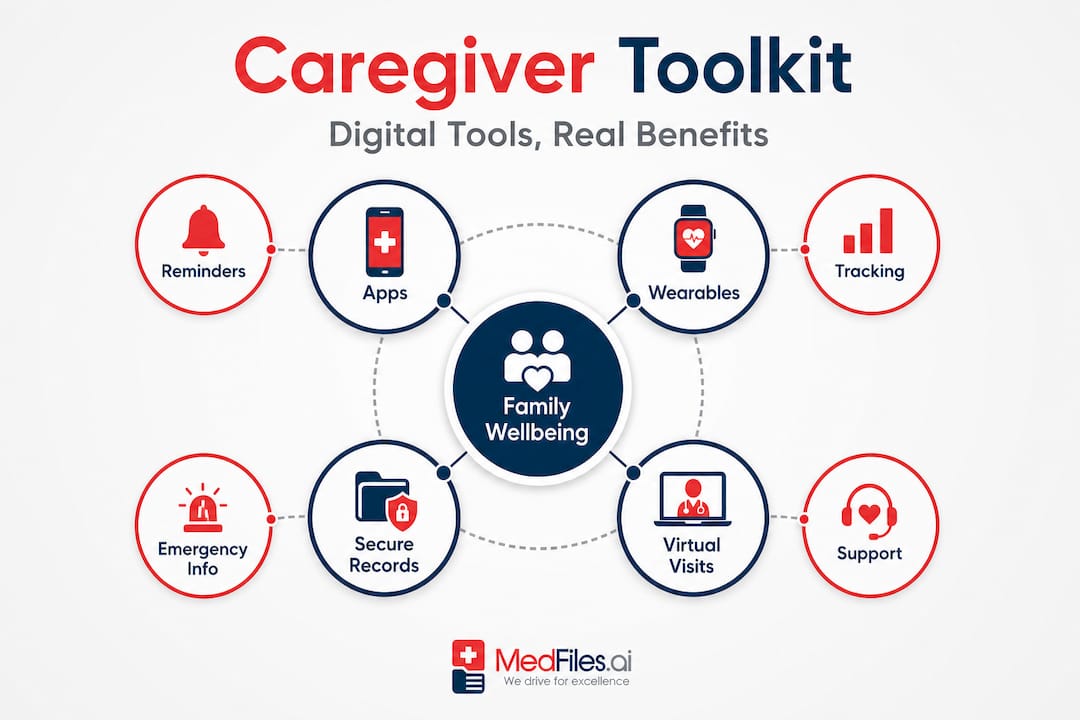
Digital health is not one single app or gadget. It is a category of tools that use technology to help you store, access, and act on health information. For caregivers managing the health of elderly relatives, this could mean several things working together.
Here are the main types of digital health tools and what each one actually does for you:
- Mobile health apps: Store medications, track appointments, log symptoms, and send reminders.
- Wearables: Smartwatches or fitness bands that monitor heart rate, blood oxygen, sleep, and activity levels in real time.
- Telemedicine platforms: Video or phone consultations with doctors, saving travel time and reducing exposure to illness.
- Patient portals: Secure online systems provided by hospitals or clinics where you can view lab results, visit notes, and imaging reports.
- Medical record storage platforms: Centralized digital storage for all health documents, shareable with providers and family members.
These tools fit into digital health benefits for families in very practical ways. Consider a typical caregiving week. On Monday, your father has a routine appointment. On Thursday, his pharmacy calls about a refill conflict. On Saturday, he wakes up disoriented and you need to call 911. A digital health system means that at every one of those moments, the right information is ready.
| Tool | Primary use | Caregiver benefit |
|---|---|---|
| Mobile apps | Medication tracking, reminders | Fewer missed doses, auditable logs |
| Wearables | Vital sign monitoring | Early warning of health changes |
| Telemedicine | Remote consultations | Faster access, less travel |
| Patient portals | Lab results, visit notes | One source for clinical data |
| Record storage platforms | Document organization | Emergency and sharing readiness |
Understanding the health management advantages of each tool helps you build a system instead of just downloading random apps. A medical records workflow guide can show you how these pieces connect into a reliable routine.
How digital health tools reduce stress and burden
With the basics covered, let’s turn to what the evidence says about the impact of these tools on real caregivers like you.
Caregiving is genuinely exhausting. Managing another person’s complex health needs on top of your own life creates a specific kind of stress that builds quietly until something breaks. The good news is that the research is clear and encouraging. A meta-analysis of 16 randomized controlled trials involving 2,716 caregivers found that digital interventions significantly reduced caregiver burden (Cohen’s d = 0.65, p<0.01) and stress (d = 0.62, p<0.01) in the short term. Those are meaningful, measurable reductions, not small trends.

What does that look like in day-to-day life? The five digital health benefits most caregivers report are faster emergency response, fewer medication errors, better communication with care teams, reduced time spent searching for documents, and increased confidence during medical appointments.
Here is a step-by-step approach to integrating digital tools for immediate, practical wins:
- Start with medication management. Use an app to create a complete, current medication list with dosages and prescribing doctors. Share it with every provider involved in your relative’s care.
- Digitize the most critical documents first. Scan or photograph the most recent lab results, discharge summaries, and specialist notes. Upload them to a secure storage platform.
- Set up a patient portal account. Most hospital systems offer this. Confirm you have authorized access as a caregiver or proxy.
- Create a simple emergency contact sheet within your digital system. Include the primary care doctor, all specialists, pharmacy contacts, and insurance information.
- Add one monitoring tool if appropriate. A basic wearable or blood pressure cuff with app connectivity can give you daily trend data without being overwhelming.
The streamlined medical data workflow you build through these steps becomes your safety net.
Pro Tip: Start with one tool and get comfortable using it before adding another. Trying to implement five apps at once creates overwhelm, not clarity. Master your medication tracker first, then layer in document storage.
Addressing real-world challenges: Usability, costs, and the digital divide
While reducing stress is a major benefit, certain challenges can make or break your experience with digital health.
Not every caregiver or care recipient can pick up a new app and run with it. The barriers are real and worth naming directly. Key challenges include poor usability, lack of training, digital literacy gaps especially related to age, costs, privacy concerns, and significant limitations for people with complex needs like advanced dementia.
Think about what this means in practice. An 80-year-old with mild cognitive impairment may struggle with small text, confusing navigation, or two-factor authentication. A caregiver on a fixed income may find subscription costs prohibitive. Someone in a rural area may have limited internet access. These are not edge cases. They are common realities for many families.
| Challenge | Expert-recommended solution |
|---|---|
| Low digital literacy | Choose tools with simple, large-text interfaces and tutorials |
| Cost barriers | Look for free tiers, family plans, or nonprofit-sponsored tools |
| Privacy concerns | Verify encryption and HIPAA-ready status before signing up |
| Complex needs | Supplement with passive monitoring sensors, not just apps |
| Resistance to technology | Involve the care recipient in choosing the tool |
Experts recommend training, inclusive design, equitable affordability, and cultural sensitivity to overcome adoption barriers. When evaluating a tool, look for nurse-delivered support, accessible help centers, and interfaces designed for older adults.
When looking for practical examples for caregivers or guidance on patient-doctor digital communication, prioritize resources that show real use cases, not just feature lists.
Here are must-have features for any caregiver-friendly digital health tool:
- Simple, clean interface with minimal steps to find critical information
- Offline access to essential records, in case of connectivity loss during emergencies
- Caregiver proxy access so you can manage records on behalf of your relative
- Secure document sharing directly with healthcare providers
- Customer support that is reachable by phone or chat, not just email
Pro Tip: Before committing to any platform, run a simple test. Can you find a specific medication name within 30 seconds? If not, the tool is probably too complex for emergency use.
When digital isn’t enough: Limitations and edge cases
Knowing the challenges, it is equally vital to recognize where digital tools cannot take the place of hands-on caregiving or may create new risks.
Digital health tools are not magic. They work best when used by someone who is reasonably tech-comfortable and managing a care situation that is not severely complex. When those conditions are not met, long-term effects are unknown and digital tools may actually exacerbate inequalities, increase the “always-on” burnout risk for caregivers, and prove far less useful for people with severe cognitive decline.
Here are specific scenarios where digital tools fall short, and what to do instead:
- Severe dementia: The care recipient cannot engage with digital tools and may not benefit from monitoring that requires their cooperation. Use passive sensors (motion detectors, smart doorbeds) instead of interactive apps.
- Multiple family caregivers with conflicting access needs: Shared access can become confusing or even lead to privacy issues. Designate one primary digital manager and set clear access rules.
- Limited internet or smartphone access: Keep a printed backup of critical documents. Update it quarterly. Digital is the goal, but paper backup is still smart.
- Caregiver burnout from over-monitoring: Constant alerts and notifications can feel like a second job. Set limits on what you track and when you check in.
- Medical complexity beyond app capabilities: Conditions requiring specialist-level data interpretation are not a good fit for consumer apps. Use professional patient portals and direct provider communication instead.
“Edge cases like dementia or multi-family caregiving highlight needs for passive monitoring such as sensors and emergency proxies, but complex proxy management erodes confidence.” Edge cases like dementia
The answer is not to avoid digital tools. It is to use them where they add real value and fill gaps with human support and simple analog backups. Knowing how to secure family medical access in a layered way, both digital and physical, is a genuine skill worth developing.
Best practices for choosing and using digital health tools
With practical pros, cons, and limits in mind, let’s see how to select the tools that work best for your unique family situation.
Choosing a digital health tool is not about finding the most popular one. It is about finding the right fit for your relative’s needs, your technical comfort level, and the specific gaps you are trying to fill. Experts recommend training, inclusive design, equitable affordability, and cultural sensitivity as the foundation for successful adoption.
Follow these steps to evaluate and implement a tool confidently:
- Define your top three pain points. Is it medication errors? Trouble sharing records with a new specialist? Not knowing what happened at the last ER visit? Knowing your problem helps you find the right solution.
- Research tools that solve that specific problem. Look for user reviews from caregivers, not just general consumers. Check if the platform has a caregiver or family account option.
- Verify security standards. Look for HIPAA-ready infrastructure, end-to-end encryption, and clear data ownership policies. This is non-negotiable when storing sensitive health records.
- Test usability before committing. Use any free trial or demo to complete a real task, such as uploading a document or sharing a record. If it is confusing, it will be worse in a crisis.
- Plan for integration with your care team. Ask your relative’s primary care doctor whether they can receive records from the platform, or whether a specific portal is preferred.
- Review your setup every three months. Health situations change. Your digital tools should grow with those changes.
The goal of digital medical records security is not just keeping data safe. It is ensuring that when you need something urgently, it is accurate, current, and accessible. Preserving a complete medical history also has a longer-term benefit: it gives every new provider a full picture without starting from scratch. That is why medical history empowerment matters as much as day-to-day record keeping.
Pro Tip: Look specifically for tools that offer secure proxy features, meaning you can manage records on your relative’s behalf with documented authorization. This protects both of you legally and makes access seamless.
A caregiver’s digital toolkit is only as good as its fit
Here is an honest perspective shaped by what most articles and sometimes tech vendors tend to leave out.
There is a tendency in the digital health space to treat more features as better. Longer feature lists. Bigger dashboards. Automated everything. But the caregivers who actually stick with digital tools are not the ones who downloaded the most sophisticated app. They are the ones who found one or two tools that genuinely reduced a specific, real pain point, and used them consistently.
The best digital health tool for your family is not the one with the best marketing. It is the one your elderly mother will not resist, the one you will actually open at 2 a.m. when something goes wrong, and the one that gives the ER nurse exactly what they need in under a minute. That tool might be simple. It might not have AI features or wearable integration. And that is completely fine.
There is also a temptation to digitize everything immediately. A better approach is to start with what scares you most. For most caregivers, the biggest fear is an emergency where they cannot communicate a loved one’s medical history accurately. Fix that first. Store the critical documents. Build the medication list. Share it with the right people. Then, once that feels stable, you can add complexity.
Digital health management wisdom is not about being tech-savvy. It is about making a deliberate choice to reduce uncertainty for your family. One organized record system, used consistently, is worth more than five apps used once and forgotten.
Balance digital tools with trusted human relationships. Your relative’s care team, your family network, and even a neighbor who checks in regularly are all part of your caregiving system. Digital tools support that network. They do not replace it.
Explore digital solutions with MedFiles.ai
If you’re ready to take a practical first step toward organized, secure family health management, MedFiles.ai was built for exactly this moment.
MedFiles.ai for caregivers offers a centralized platform where you can store lab results, prescriptions, imaging reports, and discharge summaries in one encrypted, instantly accessible place. With HIPAA-ready infrastructure and caregiver-friendly multi-profile management, you can organize records for your entire family, share them securely with providers, and access everything in seconds during an emergency. Explore MedFiles.ai pricing to find a plan that fits your situation, whether you are managing care for one relative or coordinating across a whole family. Your loved one’s complete medical history. Organized. Secure. Ready when it counts.
Frequently asked questions
How do digital health tools improve emergency response for caregivers?
Digital health tools provide instant access to up-to-date medical records, medications, and doctor contacts during emergencies, ensuring faster and more accurate information sharing. Digital health technologies enable caregivers to access information instantly for emergency situations, eliminating the dangerous delays caused by paper records or memory.
What should I do if my family member resists digital health tools?
Start with simple, low-pressure tools and offer hands-on demonstrations alongside the care recipient, and look for tools with caregiver proxy access so you can manage records without requiring their active participation. Key challenges like poor usability and digital literacy gaps are real, but the right tool design and patient introduction can bridge that gap.
Are digital health solutions secure for storing sensitive health information?
Most reputable platforms use end-to-end encryption and HIPAA-ready infrastructure to protect health data, but always review the privacy policy and confirm what happens to your data if you cancel. Digital health technologies are designed to keep records accessible and confidential simultaneously when implemented correctly.
What are the main barriers for older caregivers using digital health?
Older caregivers most commonly face low digital literacy, overly complex interfaces, and cost concerns, all of which can be addressed through training, simpler tool design, and free or low-cost plan options. Key challenges are well-documented, and choosing tools built with older adults in mind makes a measurable difference in adoption success.
Can digital health fully replace in-person caregiving?
Digital health tools enhance organization, communication, and emergency readiness, but they cannot replicate the judgment, presence, and emotional support that hands-on caregivers provide. Long-term effects are still being studied, and the current evidence firmly positions digital tools as a support layer, not a substitute for human caregiving.