Family Medical History Examples: Build a Clear Health Record
Learn how to build a family medical history with real examples, sample charts, and step-by-step guidance for tracking hereditary conditions across generations.

Family Medical History Examples: Build a Clear Health Record
Gathering your family’s medical history can feel overwhelming. Where do you start? Who do you ask? What counts as important? Many families sit down with good intentions and then freeze, unsure whether they need a formal chart or just a few notes. The good news: pedigree charts or family health portraits covering at least three generations give you a solid foundation. This article walks you through exactly what to collect, shows you real-world examples, and offers simple formats you can use today. No medical degree required.
Table of Contents
- What is included in family medical history?
- Visual formats: Family health pedigrees and charts
- Step-by-step family medical history examples
- Handling incomplete or complex family histories
- Our perspective: Why actionable examples are the real game-changer
- Start your family medical history with MedFiles.ai
- Frequently asked questions
Key Takeaways
| Point | Details |
|---|---|
| Include three generations | Track parents, siblings, grandparents, aunts/uncles, and cousins for the clearest health view. |
| Prioritize details | Names, ages, diagnoses, and age at diagnosis are the core items for each relative. |
| Use charts and digital tools | Family pedigrees and health portraits uncover hereditary risks more clearly. |
| Partial info still helps | Even incomplete histories can reveal important patterns—just start with what you know. |
What is included in family medical history?
A family medical history is more than a list of names. It is a structured record that helps you and your doctor spot patterns, assess risks, and plan preventive care. Think of it as a health map for your entire family tree.
For each relative, you want to capture specific details. According to clinical guidance, the key data points to collect include:
- Full name and relationship to you (parent, sibling, grandparent, aunt, uncle, cousin)
- Age or date of birth
- Ethnicity or family origin, since some conditions are more common in certain populations
- Known diagnoses, such as diabetes, heart disease, or cancer
- Age at diagnosis for each condition
- Current health status (living or deceased)
- Cause of death and age at death, if applicable
Covering at least three generations gives your doctor the clearest picture. That means your siblings, parents, grandparents, aunts, uncles, and first cousins on both sides of the family. Many people only think about one side, which leaves gaps.
Why does this matter? Because patterns across generations reveal hereditary risks. A single case of breast cancer in the family may be coincidence. Three cases across two generations on the same side is a signal worth discussing with a specialist.
Regular updates matter just as much as the initial record. A cousin diagnosed with type 2 diabetes last year is new information your doctor needs. Sharing updated records with your provider supports preventive care planning and helps you stay ahead of risks rather than reacting to them.
Knowing what essential medical documents to keep alongside your family history makes the whole process more organized. Lab results, genetic test reports, and specialist notes all add context to the picture you are building.
Pro Tip: Do not skip the less-talked-about relatives. Aunts, uncles, and cousins carry genetic information just as relevant as what your parents share. Ask both sides of the family, even if it feels awkward.
Understanding the preserving medical history benefits goes beyond doctor visits. It gives your children a head start on their own health planning.
Visual formats: Family health pedigrees and charts
With the details in hand, the next step is picking a format that works for you. Two main options exist: the traditional pedigree chart and the family health portrait. Each has strengths depending on your comfort level and goals.
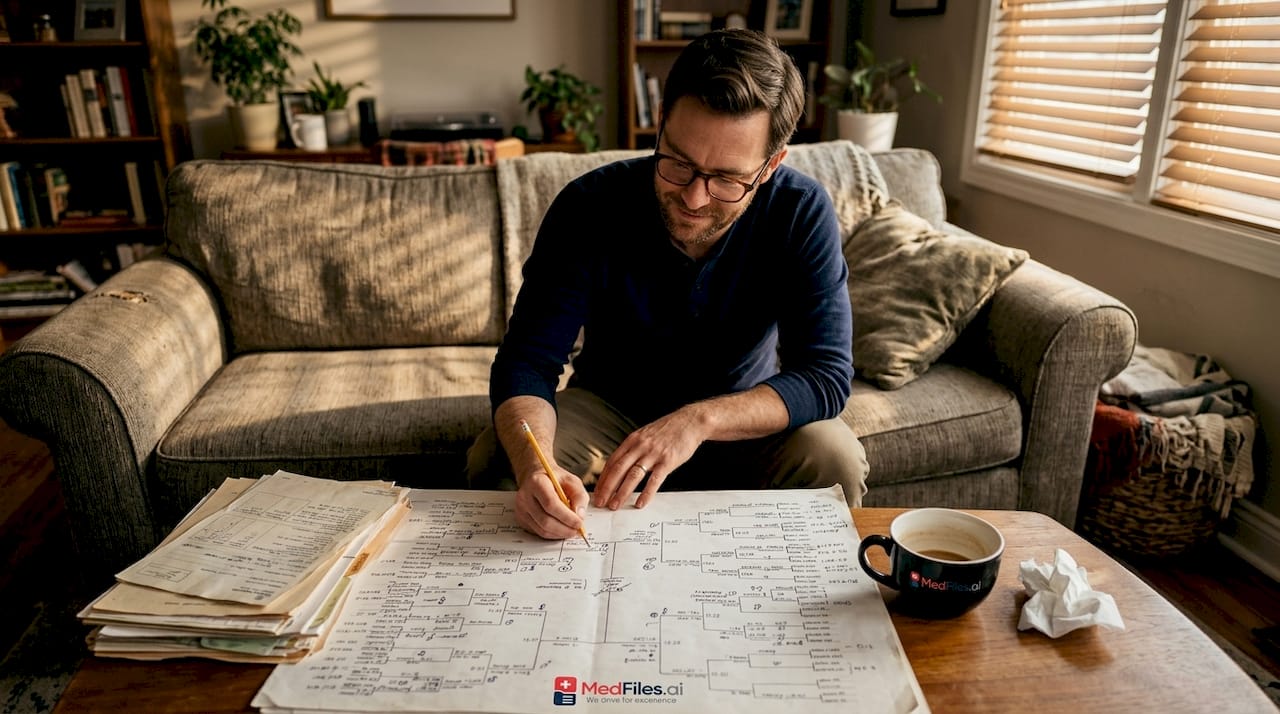
Pedigree charts use standardized symbols. Squares represent males, circles represent females, horizontal lines connect partners, and vertical lines show offspring. Shaded symbols indicate individuals affected by a condition. These charts are used by genetic counselors and clinicians because they communicate a lot of information at a glance.
Family health portraits are more narrative. They describe health conditions in plain language, organized by family branch. They are easier for non-medical users to create and read.
Digital platforms now offer a third path. Tools like the U.S. Surgeon General’s My Family Health Portrait and CDC Families SHARE automate chart creation and allow easy sharing with healthcare providers.
Here is a quick comparison to help you choose:
| Format | Best for | Ease of use | Shareable with providers |
|---|---|---|---|
| Pedigree chart | Clinical settings, genetic counseling | Moderate | Yes, standard format |
| Family health portrait | Home use, general tracking | Easy | Yes, narrative format |
| Digital platform | Ongoing updates, multi-user families | Very easy | Yes, instant sharing |
A striking fact: 96% of Americans recognize that family health history is important, yet far fewer actually document it. The gap between knowing and doing is where most families get stuck.
Digital tools close that gap. They prompt you with questions, organize responses automatically, and let you share securely. If you are organizing family records across multiple relatives, a digital platform saves significant time. Understanding a digital records workflow can also help you build a habit of regular updates rather than one-time data entry.
Step-by-step family medical history examples
Knowing the tools, let’s look at how real families can use these methods.
Example 1: Early heart disease pattern
Imagine your paternal grandfather had a heart attack at age 52. Your father was diagnosed with high cholesterol at 44. You are 38. This pattern suggests early-onset heart disease may run in your family, which is exactly the kind of signal that prompts earlier screening and lifestyle changes.
Example 2: Recessive inheritance
Both parents are healthy, but their child is diagnosed with cystic fibrosis. This is a classic autosomal recessive pattern, meaning each parent carries one copy of a gene variant without showing symptoms. The family history reveals carrier status, which matters for future family planning.
Here is a simple sample data table:
| Relative | Relationship | Condition | Age at diagnosis | Status |
|---|---|---|---|---|
| Robert M. | Paternal grandfather | Heart attack | 52 | Deceased at 60 |
| David M. | Father | High cholesterol | 44 | Living |
| Elena S. | Maternal grandmother | Type 2 diabetes | 58 | Deceased at 72 |
| Anna M. | Sister | None known | N/A | Living |
Steps to build your own chart:
- Start with yourself and your siblings.
- Add your parents and their known conditions.
- Move to grandparents on both sides.
- Include aunts, uncles, and first cousins.
- Note age at diagnosis and cause of death where known.
- Review with your doctor and update annually.
“A positive family history increases risk for many conditions. But early knowledge means early action, and that can change outcomes significantly.”
Thinking about empowering your health through documented history is not just about the past. It is a practical tool for the future.
Handling incomplete or complex family histories
Family histories are not always complete or straightforward. Here is how to work with what you have.
Adoption, estrangement, or limited family contact are common realities. Adopted or estranged families can still build useful records by requesting documents from agencies, contacting biological relatives when possible, or simply noting “unknown” where information is missing. An incomplete history is still valuable.
Here are common challenges and practical solutions:
- Missing relatives: Contact extended family members you may not speak with regularly. A brief message explaining your health goals often gets a positive response.
- Adoption: Request non-identifying health information from the adoption agency. Many states allow adult adoptees to access medical background records.
- Estrangement: Document what you know, mark gaps clearly, and revisit as circumstances change.
- Conflicting information: When relatives remember details differently, record the most specific version and note the uncertainty.
- No records at all: Start with what you know from memory. Even rough estimates of age at diagnosis are better than nothing.
Digital health platforms help here too. They let you store partial records securely, add new information as you gather it, and share access with family members who can fill in gaps. Exploring digital management benefits shows how centralized storage prevents the frustration of scattered notes and lost paperwork.
Pro Tip: Treat your family medical history as a living document. Set a reminder once a year, perhaps after a family gathering, to add any new diagnoses, births, or deaths. Small updates over time build a complete picture.
Our perspective: Why actionable examples are the real game-changer
After reviewing how hundreds of families approach this task, one pattern stands out. The families who succeed are not the ones who find the perfect format. They are the ones who start with something, anything, and build from there.
Most people get stuck overthinking structure. They want the right chart, the right software, the right moment. Meanwhile, the information they need is sitting in their relatives’ memories, getting harder to access every year.
Here is the uncomfortable truth: a handwritten list on a notepad is more useful than a blank template. Examples lower the activation energy for starting. When you see a sample chart with real-sounding names and conditions, it becomes concrete. You stop asking “how do I do this?” and start filling in your own details.
Digital tools matter, but they are not the whole answer. Conversations with your relatives, follow-up calls, and annual updates are what keep a family history accurate and useful. Tools support the process. They do not replace the human work.
The wisdom we keep coming back to: done is better than perfect. Start with what you know. Improve it over time. Exploring digital health solutions for families can help you maintain momentum once you have that first draft in place.
Start your family medical history with MedFiles.ai
You have the framework. Now it is time to put it into action. MedFiles.ai makes it simple to store, organize, and share your family’s health records in one secure place.
Upload existing documents, fill in family health details, and use ready-to-fill templates designed for exactly this kind of tracking. MedFiles.ai for patients gives you multi-profile management so you can track every family member in one account. Your digital medical history stays encrypted, accessible, and shareable with providers whenever you need it. Check out MedFiles.ai pricing to find the plan that fits your family. Start today. Your future self will thank you.
Frequently asked questions
What are the most important details to include in a family medical history?
For each relative, record their relationship to you, age or birth year, known diagnoses, age at diagnosis or death, and family ethnic origin. These details give your doctor the clearest picture of hereditary risk.
How do I find family medical history if records are missing or relatives are unavailable?
Ask surviving family members first, then request documents from agencies or adoption records if applicable. Adopted or estranged families can write “unknown” for gaps and update the record as new information becomes available.
Is family medical history useful for children’s health planning?
Absolutely. Early knowledge of hereditary risks, such as familial hypercholesterolemia, allows pediatricians to recommend earlier screening and preventive steps before symptoms appear.
Do digital health platforms improve family medical history tracking?
Digital tools automate chart creation and make sharing with providers instant and secure. They also support ongoing updates, which is what keeps a family history accurate over time.